
Tags
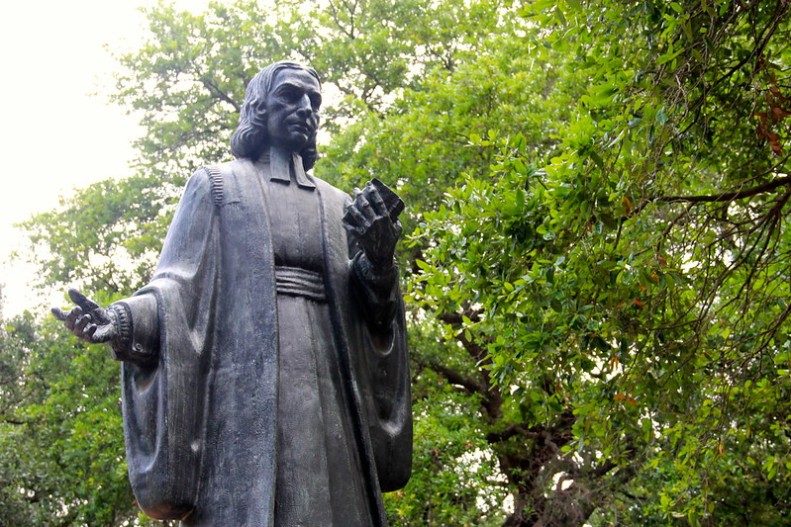
John Wesley, credit: Daniel X. O’Neil
Among the words put in John Wesley’s mouth that he did not actually say, perhaps the most common are the following:
I set myself on fire and people come to watch me burn.
or
Catch on fire with enthusiasm and people will come for miles to watch you burn.
Wesley did not say either of these.

But this may be the most persistent quote that is incorrectly attributed to John Wesley. I updated this post on April 25, 2020, and did a google search for “John Wesley quotes.” The first entry is an answer box that has a list of unattributed John Wesley quotes. Look at the second and fourth entires!
So, if you ask Google for John Wesley quotes, two of the first four it currently gives you are two quotes that he did not actually say.
It is easy to come up with numerous examples of this quote being attributed to Wesley. But what you will not find is a citation of the source where Wesley is supposed to have actually said it.
Inaccurate information spreads rapidly on the internet.
I have been surprised by the anger from some commenters on my series of “Wesley Didn’t Say It” posts. Several people have sarcastically said something like, “Oh, so you were there to hear every word that John Wesley ever said?”
Of course I wasn’t. But no historian thinks we can know what dead people said in conversations that were never recorded or written down. It is impossible to prove that someone never said something.
The standard for attributing words to someone is documentation showing they said it. For John Wesley, this would be published writings like sermons, treatises, and his published Journal or manuscript sources like letters.
I was a PhD student when I first wrote this post, so I checked in with an expert before I hit publish. I emailed noted historian of Wesley and early Methodism, Dr. Richard Heitzenrater. His response was along these lines: You can look for that quote in Wesley as long as you want, you won’t find it.
It troubles me that this quote is so frequently attributed to Wesley. It does not sound like something that Wesley would have said. In the email string that first made me aware of how often this is attributed to Wesley, someone commented that the quote was rather “braggadocious” and as a result did not sound like Wesley. I agree. It would not be characteristic of Wesley to say, “I do something awesome, and as a result people come to look at me.”
Wesley’s desire was not to attract people to himself, but to point them to the risen Lord who was their only hope of salvation.
Wesley didn’t say, “I set myself on fire and people come to watch me burn.” We should stop saying that he did.
You can add this quote to other quotes that are stubbornly connected to John Wesley despite the fact that there is no source that connects them to Wesley’s pen. I have written about several other quotes misattributed to John Wesley:
“In essentials, unity; in non-essentials, liberty; and, in all things, charity.”
“Personal and social holiness“
“Be present at our table, Lord…“
Do you want to know if Wesley did actually say something that is attributed to him? Check out Did Wesley Really Say That? (Here’s How to Find Out).
Kevin M. Watson teaches, writes, and preaches to empower community, discipleship, and stewardship of our heritage. Connect with Kevin. Get future posts emailed to you. This post was updated on April 25, 2020.
 Kevin M. Watson
Kevin, I think some form of the quote goes back to the 16th century with the burning at the stake of either Latimer or Ridley during “Bloody Mary’s” reign.
Try this: ‘Be of good comfort, Master Ridley, and play the man. We shall this day light such a candle, by God’s grace in England, as I trust shall never be put out.’
This is not the exact quote, but I think the quote you’re chasing can be traced to this event.
Wow I’m guilty. I just quoted this last week.
Thank you for sharing. It’s like the book of hebrews attributed to Paul though he probably didn’t write it. I’m going to stop now
Another one i wish people would quit quoting (so to speak): http://web.me.com/craigadams1/Commonplace_Holiness/Blog/Entries/2010/2/1_I’m_Tired_of_Seeing_this_on_Twitter!.html
(Sorry, there’s an exclamation point in that link. Copy and Paste is necessary.)
Concerning “I set myself on fire” my private theory (and that’s all that it is) has been that it is something out of Tyreman, since it cannot be found in Wesley’s published works. Methodists used to quote Wesley liberally without giving citations.
But, then again if Heitzenrater says it’s bogus….
Pingback: The Rundown « A Heart That Burns
Kevin,
First let me say that it’s great to see younger men (no offense intended) with a passion to pursue Christ wholeheartedly. Our world needs more of them. For that matter, it needs more men who display Christlikeness. I hope you enjoy this quote by Edwin Cole, ‘Manhood and Christlikeness are synonomous’.
My views on a couple of things here. While you may not find record that he said this, it doesn’t necessarily mean he didn’t.
The first time I read this quote I didn’t in any way think it braggadocious. Quite the opposite. In context with the his story of why it was quoted, it brought me to my knees in tears asking for this fire of passion that would stand up in the face of opposition and resistance to God doing a new thing at that time and in our time.
I don’t believe that this quote would have been drawing attention to himself. I believe each day we need to ask God to set us on fire. I would use the term, I need to set myself on fire for God. This is not an arrogant statement, but one of fact. God will not violate our will. He asks us to cooperate with him and if we don’t set ourselves on fire it’s because we are wet wood, or a lamp under a basket.
God commands us to ‘stir up the gift’. To stir up means to fan into flame, or to set ourselves on fire as the quote states.
The fist time I heard this was from a business book by Mark Sanborn. God is at work in every facet of society. It’s not too often you hear preaching with such passion, let alone a business book.
I’d like to leave one other quote with you that has made an impact in my life.
‘You can be one of God’s thousands of failures, or few successes. But it is going to require a higher degree of holiness, and a greater understanding of intercession.’
Be blessed,
Bill
Wahhhh… time waster. You have no real evidence that it wasn’t him. So all i’m saying is that you are just complaining about something you are completely unsure of yourself. You were heard so your objective is complete but your ability to bring any resolve is dead…
Pingback: How to stop a meme? « John Meunier
http://www.snopes.com has a Religion section; a page of Wesley misquotes may be a little too specialized for them, but you could ask.
Kevin,
Two thoughts:
1. To agree with Bill, “I do something awesome” is nowhere in this quote – It’s more of “I realize I can’t do anything on my own, not even heal an ant, and I must abide in the Vine, really.”
2. What exactly is the point behind who the quote is from? Would you be pointing out that the “founder” of less “fiery” denominations never said such things, so it’s fitting to lack the “fire”? I’m just not sure why it matters.
Dave
Bill, Dave, and Anonymous –
One of the major motivations for me in writing this post is that I am an historian of early Methodism. Perhaps it is an occupational hazard, but to me the details matter. John Wesley’s life and written words have been chronicled with quite a bit of detail. Because of his fame in later life, libraries and private collectors have originals of many of the letters he wrote. We also have published versions of all of his published journals, extant diaries and more than 100 sermons. Of course every word he said is not captured in his published works. However, the phrase in this post does not occur in anything that reliably comes from John Wesley.
The only motivation behind the post is that there is no historical evidence that Wesley ever said “I set myself on fire and people come to watch me burn.” There is no deeper ideological or theological issue behind this. For what it is worth, in discussions with other scholars in Wesleyan Studies or Methodist History, no one has ever suggested to me that they have any evidence or reason to believe Wesley did say it.
From my perspective, whether you like the quote or not does not make it more or less likely that Wesley actually said it. I also think people are free to continue using the quote. My preference would simply be that they not attribute it to John Wesley.
Blessings,
Kevin
Also…to say ‘you can’t prove he didn’t say it’ is not a good defense or response. I might as well attribute something like “There is no charge for awesomeness or attractiveness” to Wesley. Well, you can’t prove he didn’t say it. 😉
As a fellow student of Wesley and early Methodism, thanks, Kevin for posting this!
I stumbled on this article while trying to authenticate this quote to Welsey, because I heard it in a sermon and wanted to use it myself but of course needed a primary source instead of a secondary one. From what I heard of this quote, it was in the context of a conversation someone had with Wesley rather than Wesley writing it himself, therefore the quote would not be in his work but someone else’s. Has this angle been researched?
But as a proclaimer of truth it is vitally important that what I say is true even in small matters of attributing quotes to the right people. So thank you for this material!
Okay, we get it! Would you have been any less offended if he attributed the comment to “someone once said . . .”?
Great dialogue. I was going to reference Wesley on this one, but chose to do some last minute sniffing around to see if I could find a citation as to the sermon or journal entry that contains this quote. Pretty pleased to have stumbled upon this post and its comments.
Vick, your thoughts of September 18, 2011 reminded me of something: I was leading worship one Sunday in the summer of 2000 and made reference to Song of Solomon 2.10, singing “Arise my Love, my beautiful one and come with me…” as an impromptu refrain. With all the right intentions, I ‘worship-led’ extemporaneously with “This is Jesus speaking to the church…” It was a simple enough thing to say, jumping on board with the ‘allegorical interpretation of the Song of Songs’ in a live moment. However, there was a seminary prof there who took me out for coffee the next day, confessing that I had, with all my enthusiasm and worship fervour, created a wall during our singing time that prevented him from getting anything out of the rest of the gathering. Apparently he was not a fan of the ‘allegorical interpretation of the Song of Songs.’
When asked how I could have more meaningfully led the people through that moment, he said “If you would have said something like ‘Imagine this is Jesus speaking to his church’ I probably would have been fine.”
‘Someone once said…’ seems to be a similar shock absorber.
These little land mines are buried all over a congregation, waiting for someone to carelessly set them off. I’m pretty grateful to this crowd and to Kevin Watson for giving me one less spot to unwittingly blow myself (or at least some of my credibility) as I navigate any given Sunday morning without a really good map.
Pingback: A BURNING HEART? « A Heart That Burns
Darryl Dozlaw mentioned, “This is Jesus speaking to the church…” and the ‘allegorical interpretation of the Song of Songs.’
Is it incorrect to see Canticles as Jesus and His beloved? I certainly hope not, for it is a massivley powerful encouragement to me.
Pingback: Happy Birthday Church: Making Yourself Into A Living Birthday Candle This Pentecost. « myhopebox
In 15 Characteristics of Effective Pastors: How to Strengthen Your Inner Core …
By Kevin W. Mannoia, Larry Walkemeyer (http://books.google.com/books?id=Nrup8vKd7gcC&lpg=PA124&dq=I%20set%20myself%20on%20FIRE%2C%20they%20come%20to%20watch%20me%20burn&pg=PA123#v=onepage&q&f=false) he says that Wesley said that to Anglican Bishop
Yes, and just as it always is on twitter, there is no attribution to the quotation in the book you cite. It is a great story, but this citation does nothing to undermine the reality that there is no historical basis (beyond people asserting that he said it) for Wesley having said this.
Actually none of these people wrote this. The quote is taken from scripture. Jeremiah 5:14. When applying that scripture to yourself, when preaching, you get the famous quote.
“Fear God and give glory to Him, for the hour of His judgment has come; and worship Him who made heaven and earth, the sea and springs of water.”
I think it would be an interesting study to analyze the uses of such falsely attributed quotations: why are they used? in what settings? why Wesley? what does it say about the authority that Wesley quotes wield in certain circles? wave Wesley’s words always been used in such a manner? was there a day or time when Wesley’s words would have had no cache, thus people would have gained little by attributing such phrases to him?
David, I completely agree. I think this would be a fascinating study!
Pingback: Where the “Set yourself on fire with enthusiasm” misquote of Wesley may have come from | wesleyanrudy
Pingback: Wesley Didn’t Say It: “Holy Conferencing” | Vital Piety
Pingback: Things John Wesley did not say | John Meunier
Pingback: Do Mundane Things. Get Your Ideas Accepted by Working Behind Enemy Lines, and Don’t be a Martyr. | What's the PONT
I realise I’m a few years late (!) joining in this conversation about the wrong attribution to Wesley ( which I discovered by accident when I googled ‘people will come to watch you burn’ this morning) but if I may, an offering from a Brit sitting in Oxford a mile or so from where Wesley held his first Methodist meetings – you might enjoy this:
‘There may be a great fire in your soul, yet no one ever comes to warm himself at it, and the passers by only see a wisp of smoke coming through the chimney, and go along their way. Look here, now what must be done? Must one tend the inner fire, have salt in oneself, wait patiently yet with how much impatience for the hour when someone will come and sit down – maybe to stay? Let him who believes in God wait for the hour that will come sooner or later’
from: The Complete Letters of Vincent van Gogh, Vol 1, p197 – (and yes, that definitely is a correct attribution!)
The way I’ve heard it was, “Get on fire for God and people will come to watch you burn.” This was an appeal for impassioned, Holy Ghost filled evangelism.
As for a biblical basis, how about John the Baptist’s words: “He will baptize you with the Holy Spirit and fire” (Luke 3:16), the fire of zealous love (Song 8:6)? John would know, Jesus referred to him as a burning lamp (John 5:35).
Lord, fill us all with the fire of your love, igniting a holy passion for your Name among all your people, that the world might also believe!
Pingback: Commonplace Holiness Blog
I was at first bothered by the need some have to nail down, with precision, if Wesley said this or not. I mean, the quote sums up evangelism so well. Who cares who said it? But then God said, “If there were no people like Kevin Watson, there would be no Old Testament, no New Testament, no translations, no history.”
I can love the meaning behind the quote and still honor those who fulfill their purpose in watching over truth. Thank you, Kevin, for helping us stay honest. It most certainly does matter who said what and when.
Pingback: Famous Christian Quotes That They Never Said – Dr. Jeremiah Gibbs
Pingback: Wesley Didn’t Say It: “Be present at our table, Lord…” | Vital Piety
Pingback: The One Solution Out of Our Reach - ijoey.org
It’s from Spurgeon.
Pingback: Check Your Quotes – Day 10 of 30(40)
Pingback: Finding life in communion | the preacher and the party store
Sincerely, I enjoyed the post and comments. While I was going through the various comments by a lot of bible scholars in this forum I began to be assured that the gospel of Christ actually has a future in our various realms. I am of the opinion that the inspiration always created by this quote shrouds even the general we attribute it to. It has set many charlatans on an insatiable search for God and I could be right to believe the supposed source is correct until proven otherwise
Pingback: Are We Called to be “On Fire”? | David M Schell
Ok! Ok! I said it!!! “)
I beleive it was Billy Sunday who said that.
I always loved this quote and believed it to be from John Wesley or at least someone from that genre. I felt it worth contacting you personally because in March I discovered that the quote comes up in my deceased auntie Eileen’s diary from 1951. She was an ardent evangelist and diligently cut out little verses from her bible and glued them into a counselling book she created for evangelistic purposes. So even if this quote didn’t come from Wesley, she thought it did and wrote about it in 1951 along with her desire to be as effective.
You keep repeating the same refrain “Wesley didn’t say it!” but you give no evidence to prove that he didn’t. Neither do you attempt to search for the identity of the person who presumably spoke these words.
Dear Tyrone,
How would you expect me (or anyone) to prove that a dead person did not say something? Please think about what you are asking. It is an impossible and unreasonable standard. If we are entitled to say Wesley said this quote because I cannot prove that he didn’t say those words out-loud to someone who heard them, but neither of them wrote down anywhere that has been preserved that he did say them, by that logic I am also entitled to put any number of impossible quotes in John Wesley’s mouth (or anyone else). I could say that John Wesley said: “The Houston Astros are my favorite baseball team.” It would be absurd for me to sincerely believe he said this. But based on your standard, you could not prove to me that he did not say it. And, as a result, you seem to feel one is entitled to say he did say it.
The accepted practice in the field of history is that you are not entitled to say that someone said something unless you can find it in their extant writings. In order to say someone said something you must be able to actually quote it from a reliable source known to come from them. Scholars in Wesley Studies are unanimous in their agreement that this quotation does not occur in John Wesley’s writing. This serious of posts has pointed out the quotations commonly attributed to John Wesley that there is no evidence of him having ever said based on what historians can know.
To your second point: The purpose of the post is not to show who did write this particular quotation. The purpose is to point out that there is zero evidence that Wesley did say it. Therefore, we should stop attributing it to him.
I hope this clarifies things a bit.
All the best,
Kevin M. Watson
From a legal standpoint, if it is not on paper it did not happen. The burden of proof is on the person wishing to prove that Wesley did say it, and in order to prove it the documentation must be produced. I don’t often quote Christopher Hitchens but as we all know even a broken clock is right twice a day. Hitchens razor claims that whatever can be asserted without evidence can also be dismissed without evidence. Sadly Hitchens passed away believing that Christianity had no evidence. He knows the truth now. But speaking of those who have passed away, Wesley may not have said it but if not he probably wishes he did!
This is what I find particularly astonishing Kevin.
I came online just to find out more about this quote. It was not as much the quoter but the quote itself; and this is good in that I was going to find out more about Wesley from this one quote. So I guess I could try to understand the point you are trying to make but I wonder what injustice this would be if you turned out to be wrong about this. You just had better be right.
I would like to appreciate your meticulousness, but I am not sure I do and you have to ask yourself, why you started out the post like this:
Among the words put in John Wesley’s mouth that he did not actually say, perhaps the most common are the following:
I set myself on fire and people come to watch me burn.
Wesley never said that.
If you do a google search, you will easily come up with numerous examples of this quote being attributed to Wesley. What you will not find is a citation of the source where Wesley is supposed to have actually said it.
There is absolutely no brooding over the words themselves and a subtle ‘ btw this may not have been Wesley’: You just straight went for the jugular. Kind of like killing the whole thing. In trying to take out the emphasis from Wesley, you took out the emphasis from the quote itself. What a quenching atmosphere this post has and quite ironical because the post talks about fire.
I am not sure if that was the intent but I am grateful for the sake of the many people that it seems were helped by this information.
You can’t always be appreciated in Ministry, and I am sure you get this a lot. I just hope your work has a better effect on many people. I wish I was the outlier.
I bid you God’s grace and mercy.
I forgot to mention this:
Do you know that your post is the topmost result on the web for the quote?
The emphasis you have taken from the quote and have put on Wesley or not Wesley more appropriately.
That was my point. I wanted to find out more about the quote and after seeing your post, I have to add extra effort to do so now because it has a quenching atmosphere.
“Set yourself on fire with passion & people will come for miles to watch you burn.” in no way to me is saying “go do something awesome, and make a spectacle of yourself” to me it’s using the word passion as it would be understood at the time of John Wesley and meaning “Connect to Christ in such a transformative way that your life burns so brightly that His light burning through you will draw others from miles around in.” It lines up with Wesley’s experience of seeing the confidence of faith and joy that the Moravians during the storm at sea that John Wesley thought would end his life. Wesley was a priest, but the Moravian’s faith, burning passionately during the storm lit a spark that culminated in Wesley’s encounter at Aldersgate… So whether he said it or not, he definitely experienced it.
Pingback: Top Ten Most Read Posts of the Past Year and What I Learned | Vital Piety
Pingback: Wesley Didn’t Say It: Do all the good you can, by all the means you can… | Kevin M. Watson
Pingback: Wesley Didn’t Say It: Unity, Liberty, Charity | Kevin M. Watson
Pingback: Top Ten Most Read Posts of the Past Year and What I Learned | Kevin M. Watson
Pingback: Wesley Didn’t Say It: “Personal and Social Holiness” | Kevin M. Watson
I find this interesting because of my personal connections to John Wesley. Early memories include my Methodist upbringing, events at Epworth by the Sea, where Episcopalians and Methodist both honor Wesley’s ministry, the fact that I later bought land very near Christ’s Church on St. Simons Island… the fact that my great grandfather and his twin brother were ministers and named for Wesley, and that my twin sons are in seminary today, and one of them is also named for Wesley… therefore, quotes by the Wesley brothers drive a passion in me. All this being said, theologically Wesley may not have been quite so loose with his words… However, recognizing the fact that he believed in the Holy Trinity, and the in-filling of the Holy Spirit, he may have said something similar… such as, “Be passionate, and let the Spirit of God burn within you, and people will come from miles to see His glory”! Now that might sound more like John Wesley. Either way, I believe John Wesley was passionate and on fire for God, and if we ask God to fill us with His love and power, we can burn just as brightly… and in doing so, people who are hungry for the Truth will come from many miles to see and experience for the power of God!
I agree Marshall.
Thanks Kevin! Now I’m going to search who did say this if anyone?
In your entire presentation, You present no proof that “Wesley didn’t say it”, yet you title your message as such with confidence. This comes off as clout chasing, a tendency which is distracting, divisive and a waste of energy in the body of Christ.
Daniel Ajuzie’s post above summarizes things succinctly, this article creates “quenching atmosphere” and unnecessarily so. The absence of citation does not in anyway confirm “Wesley Didn’t say it”. History is replete with information that was passed on from person to person during non-official/casual conversation. I encourage you to focus on the fundamentals of John Wesley’s ministry, fan to flame, working out one’s salvation and being on fire for God in general. Highlighting irrelevancies like this for the sake of historical/academic argument is weak.
What “Watchman” and Daniel fail to understand is twofold: One, Dr. Watson is an historian and a Wesley scholar. He’s more reliable than some webpages on the internet because he’s actually read Wesley’s works and studied them. Two, I have a digital copy of the Works of John Wesley which is a multivolume set of pretty much everything the man ever wrote. Since the search function works really well, I can search the phrase “set myself on fire” and see how many times it occurs in the writings of Wesley. The result? Zero times.
Truth and accuracy are important because God is Truth. If you’re willing to pout because someone is doing good historical work to correct historical inaccuracies, the problem isn’t Kevin, it’s you.
Hey, Kevin. Thanks for your input.
So, if Wesley didn’t coin the “I set myself on fire…” phrase, then who actually did?
Mark
Ten years later… The article is sound, logical and clear. Then I read the comments and just have to shake my head. The responses of, “But you didn’t prove that he DIDN’T say it!” are astounding.
So, here goes: “I like flies in my pudding.” — John Wesley
Now, PROVE he didn’t say that.
So if Wesley did not say it, why not tell us who did? Have you researched that?
Pingback: John Wesley: I set myself on fire… | Practical Theology
Next you’re going to tell me there’s no Santa Claus. I hate you. 😉
I shall especially miss attributing the “As to essentials, unity…” quote to Mr. Wesley, though at annual conference a decade or so back, that was the theme although it was admitted at the time that no one had been able to authenticate the same.
Thank you. Trust but verify. I Thessalonians 5:21. I think the quote sounds more like a circus exposition and not a call to hear the Word of God.
It’s nice to get clarification on facts. I think a good way to end the article would be to say something like, “But here are some great validated quotes from Wesley worth chewing on.”